
On a humid July evening in Zagreb, a friend from Split told me she’d rather swim to Italy than set foot in Albania. That casual dismissal。voiced over a glass of Karlovačko, captures the quiet unease many Croatians feel about their southern neighbor. Croatia vs. Albania isn’t a headline rivalry like Spain vs. Portugal or a blood feud like Serbia vs. Kosovo. It’s a low-frequency friction—part tourism economics, part wartime memory, part confusion over two flags that share red, black, and a double-headed eagle.Look at the maps. Croatia’s coastline is a jagged crescent, 1,777 kilometers of it。
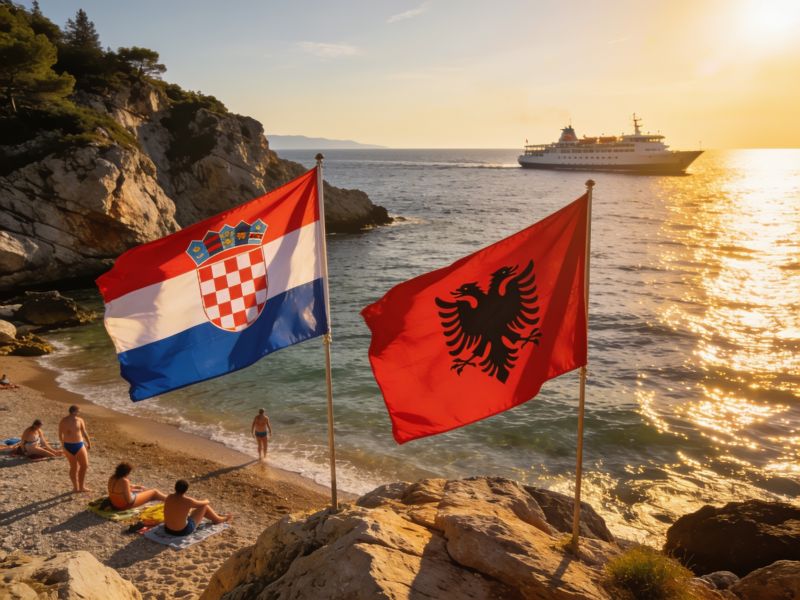
swallowing nearly all of the Adriatic’s eastern shore. Albania gets a sliver—about 476 kilometers—from the Montenegrin border down to the Greek one. This asymmetry breeds a specific anxiety. Croatian hoteliers in Dubrovnik and Hvar watch Albanian resorts in Ksamil and Saranda undercut their prices by 40 percent. I’ve heard Croatian tour operators grumble that Albanian beaches offer the same limestone coves and clear water “without the UNESCO surcharge” The comparison stings because it’s not entirely false. Meanwhile, Albanian entrepreneurs in Tirana shrug: “They had a war to sell. We had a dictator to survive” That gritty pragmatism defines much of the Croatia vs. Albania dynamic on the ground.The football pitch offers a sharper lens. Croatia’s 2018 World Cup run made Luka Modrić a household name from Osaka to Omaha. Albania’s first major tournament appearance—Euro 2016—produced a single win against Romania and a viral video of players crying. When the two sides met in a friendly in 2022, Croatian fans in Tirana’s Air Albania Stadium chanted “Kosovo je Srbija”—a gesture that Albanian spectators met with whistles and a banner reading “No to genocide denial” The match ended 1-1, but the post-game commentary revealed deeper discomfort. Croatian sports papers framed Albania as “a rising threat to our UEFA coefficient” while Albanian pundits accused Croatia of “arrogance inherited from Yugoslavia” The Croatia vs. Albania fixture rarely produces beautiful football;it produces sociological clues.History doesn’t help. During the 1990s, Croatia’s war for independence earned Western sympathy and a steady flow of arms. Albania’s parallel collapse into pyramid-scheme chaos in 1997 drew pity。not partnership. Croatian veterans I’ve spoken with in Vukovar admit they know little about Albania beyond “Enver Hoxha’s bunkers” and “that rapper who bought a tank” Younger Albanians in Durrës, meanwhile, consume Croatian pop music and vacation in Istria but resent visa requirements that Croatia—now in Schengen—imposed until 2023. “They treat us like we’re still the poor cousin” a 28-year-old bartender told me. “But check the ferry schedules. Half of Dubrovnik’s season staff is Albanian. We’re the ones pouring their wine”None of this means Croatia vs. Albania is destined for hostility. The two nations share a love of grilled lamb, Byzantine church ruins。
and a healthy suspicion of Brussels. In 2023, Croatian President Zoran Milanović—hardly a diplomat—called Albania “our strategic partner on the Adriatic” The phrase sounded canned, yet it reflected a grudging recognition: if Croatia wants to keep its tourism monopoly, it needs Albanian labor. If Albania wants EU accession by 2030, it needs Croatian bureaucratic know-how. The rivalry is real, but it’s the kind that plays out in ferry queues and football chants, not on battlefields. That’s progress, of a sort. Still, next time you see a Croatian flag with a checkered shield and an Albanian flag with a black eagle, look twice. In the Balkans, even the colors lie.